Who’s in the Clinic & How Do We Keep Up?!

Young Swainson’s Hawk Reunited With Family

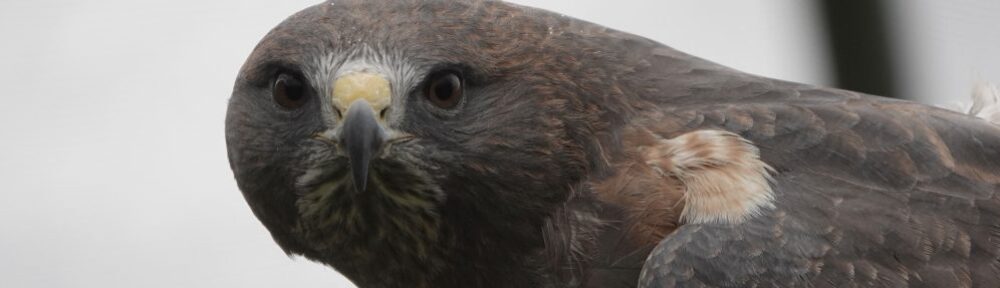
After using acetone to remove pitch from the young hawk’s feathers, he was placed in a tree next to the pitch producing pine tree where had come from. You might wonder why we would do that? His parents (in my view) are much better equipped to teach him how to be a successful Swainson’s Hawk than we humans. We could place him in a hack box for two weeks to get him used to being fed in that location and then release him and keep supplying food, but he would not have the benefit of interacting with his parents. 

The Baby Board

Our lives are currently ruled by the baby feeding board. The column on the left lists the birds: House Finch, Barn Swallow, American Robin,Western Kingbird, Say’s Phoebe, another Western Kingbird and Common Raven and what they are fed. Across the top are the feeding times between 7:00 am and 8:30 pm (the days are getting shorter so we no longer feed until 9:00 pm). Each dot represents a time when the corresponding bird is fed. 

Least Chipmunk

These tiny Chipmunks (weighing 22 grams which is less than an ounce) were found in a parking lot on Weston Mountain near Jubilee Lake. Being fully furred with their eyes open, they do not need to be fed formula, but they do seem a little young to be separated from their family. we will do some research to determine when we should return them to Weston Mountain.

More Songbirds

An always hungry Western Kingbird…

And two American Robins…

Revolving Door At The Center

Daily temperatures are hovering around 100 these days, so I guess I shouldn’t refer to them as extreme, but rather typical July temperatures. We are rotating several sprinklers in and around the various flight pens and mews to provide some evaporative cooling for the birds.

Thursday was release day: one Scrub Jay was returned to Hermiston.

Samantha released one House Finch in Milton-Freewater while Tricia and I released four House Finches at McNary Wildlife Refuge. 

Admissions were varied, although did not include a Varied Thrush. Most were youngsters, about ready to fledge, including a Say’s Phoebe:

A Downy Woodpecker with a head injury who is improving and able to “find” mealworms in a dish, and eventually dispatch and eat them, with a little help:

A Cassin’s Finch with the ubiquitous “finch eye” which we are treating with topical and systemic medications. We rarely see a Cassin’s Finch.  They are larger than a House Finch and found in higher mountainous regions where people don’t tend to be.

And a young Swainson’s Hawk with pitch on his feathers. Acetone seems to be fairly effective at removing the pitch. I think he will be ready to return to his family after one more session of feather cleaning.

We also had human visitors this past week. A group from the Tribal Summer Youth Program…

And young bird watchers from Robin’s Daycare…

Can You Find the Owl?

We have released five young Western Screech Owls at a hack site just down the road from the wildlife center. They are still roosting in nearby trees and returning for food as they perfect their hunting skills. Can you find the owl who was watching Tricia as she placed mice on top of the hack box this past week? 

We are in for an extended hot spell. If you can turn on a sprinkler in an out of the way corner of your yard and provide a shallow bath pan, the birds will appreciate it. During the heat dome of 2021, when the temperature reached 117 degrees, even Great Horned Owl Sage appreciated a sprinkler…

A Week of Extremes

We have had several days of extreme heat. It’s been extremely dry, with no rain in sight and baby birds that are extremely small, 2 gram hummingbirds, and very large, a 2,000 gram Raven. The hummingbirds are in an incubator in the main clinic. 

The Raven appears to be healthy, but because it is a high risk species for Highly Pathogenic Avian Influenza, it is in the quarantine building. We will be able to test it for influenza on Monday, and should have the results back by Wednesday. If the results are negative, as we expect,  the Raven can then be moved into the main clinic.

Hack Site Updates

Five Western Screech Owls (WESO’s) have been released at the WESO hawk site. Tricia spotted two in the tree housing the hack box when she dropped off some mice a couple days ago. We use trail cams to monitor the WESO’s and will keep supplying them with mice as long as they are coming back for food. Once they have perfected their hunting skills, they will prefer freshly caught mice to mice that have been previously frozen.

Six Great Horned Owls (GHOW’s) have been released at the GHOW hack site. They are also still returning for food, along with some resident owls that have figured out where to get a free meal! 

Walla Walla Science Camp

Campers attending the science camp toured the center this past week and dissected owl pellets. The pellet below contained bones from at least four rodents. It was cast by a well-fed Barn Owl!

Owls and Summer Programs Last Week!

A Barn Owl nest was discovered when the tarp covering the haystack was removed. The owlets were brought to the Pendleton center. There were 9 owlet’s (one was just coming out of its shell) and an egg.  Like other raptors, Barn Owls lay their eggs at intervals of two or three days. The six older owlets…

And the 3 younger owlets…

The owls have been transferred to the Benton City center so they can be hacked out.

Hermiston Summer Parks & Walla Walla Valley Camps

On Thursday, Hermiston Summer Parks students each visited the Pendleton center. On Friday students from Walla Walla Valley Camps visited. They met BMW’s education birds… 

Played the migration game and learned about some of the obstacles migrating birds face like windows, toxic water, power lines, wind turbines and vehicles… 

And dissected owl pellets…

Babies in all shapes and sizes

The babies keep coming. The Pendleton Center admitted 3 Northern Harriers (ground nesting hawks), 4 baby Skunks and a Hummingbird. The Harriers were inadvertently “rescued” by well-meaning folks who thought they were being attacked by a hawk, no doubt one of the parents. It took 2 1/2 days to organize a return trip to La Grande for the Harriers and recruit a new volunteer, Tom, to keep eye on the youngsters until the parents realized they were back.

The Harriers were color-coded so we could tell them apart in the clinic, and banded before their trip home. They are well-suited to hiding in tall grass.

Four Baby Skunks

These young skunks were orphaned when their mother was struck by a car and killed. They are eating solid food and soon will be moved outside to grow a little bigger and learn to forage for food before being released.

A Very Young Hummingbird

At three grams, this nestling Hummingbird is almost full-grown. It is the youngest hummingbird we have admitted… still begging to be fed. Adult hummingbirds eat a very low protein diet, getting most of their calories from the nectar of flowers. They also eat tiny flying insects which are what they feed their fast-growing babies. We are feeding this guy tiny mealworms and blood worms. 

BMW Volunteers to the Rescue Again

Yakima volunteers Kathy, Bill and Ken responded when a Raccoon was struck by a vehicle and killed while trying to cross I-82 near Yakima. Her 3 kits were stranded in the freeway median under an overpass with cars zipping by on either side at 70 miles per hour. A Washington State Patrol trooper stopped, but said he could not stop traffic for raccoons. Kathy and Ken caught the first kit, then Bill arrived with a large salmon net and quickly caught the other two. The kits were not very grateful, but I’m sure they owe their lives to Kathy, Bill and Ken. They took them to BMW’s Tri-Cities center where they were examined and found to be in good condition. They will coordinate with Washington Department of Fish and Wildlife once the kits are ready to be released. Thank you for a job well done!!!