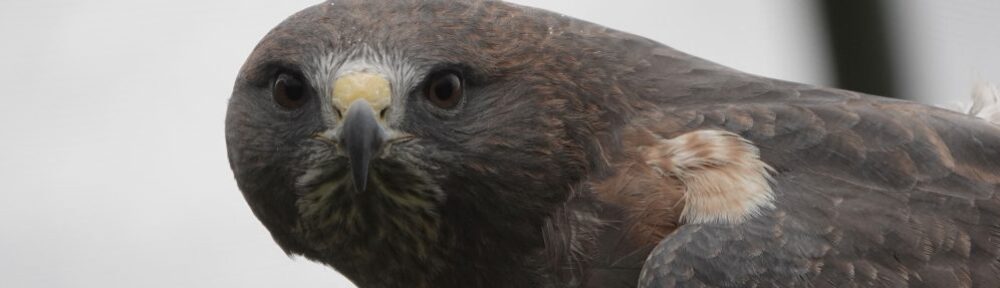
Veterinary Technician student Brooke helped band a Swainson’s Hawk, then she and Tricia placed the hawk in a hack box.
Two Swainson’s who had been released earlier in the month soared overhead.
Those were some of the high points this past week. There were trauma cases that could not be helped other than to provide humane euthanasia.
Swainson’s Hawk 26-398 had an old fracture of the right humerus.
Barn Owl 26-399 had a left coracoid fracture. The swelling in the shoulder made it difficult to get good positioning. The x-ray below is an H-view. We used a partial roll of vet wrap under the bird. It is a view we often use to evaluate an injury in the shoulder girdle.
There is asymmetry in the shoulders of Common Nighthawk 26-400. Nighthawks are arial insectivores. The bird weighed just 25 grams, more than 50% below a normal weight of 62 grams. We suspect it was starving after being injured in a collision. We are generally unsuccessful in saving birds that are more than 40% underweight.
Black-headed Grosbeak 26-401 had fractures in the left radius and ulna.
American Kestrel 26-402 had his left wing sheared off. Its hard to imagine how this injury occurred.
On occasion we admit mammals. Friday, Tricia coordinated with ODFW at Ladd Marsh and released two young Striped Skunks. They immediately began exploring their new home.
This past week we were privileged to watch two of the Swainson’s Hawks released from a hack box soar effortlessly above the wildlife center. BMW Treasurer Kirsti took the photo below.
Then Kirsti spotted Short-eared Owl Sally in her favorite location…
Next came a coping session with Golden Eagle LB, a beak and talon trim…
Then Tricia showed the interns Ava and Brooke how to position a bird for an x-ray…
We bid a fond farewell to intern Ava as she heads back to Idaho for school. She worked hard for 6 weeks and was an excellent role model for incoming intern Brooke.
We bid a fond farewell to intern Sophie. She will continue her studies at Northern Arizona College with the goal of becoming a wildlife veterinarian. We wish her well and know she will benefit wildlife for many years to come.
We had a busy week with lots of trauma cases. Fortunately there were successes too. Tricia and the interns took a road trip to release birds: a Mourning Dove, an American Robin and an American Crow. Ava released the Robin.
Sophie released the Crow. It’s feathers were in poor condition at the time of admission, the result of a poor diet from the well-meaning individual who found it on the ground. Initially we thought it would need to molt before being able to fly well enough to be released. Once it was at a normal weight, it was moved outside to a flight pen. Its flight improved dramatically and Sophie released it where it had been found.
An injured Hoary Bat was found in the Pendleton Safeway parking lot. Sadly there was too much damage to the bat’s right wing to repair and it was humanely euthanized. At 25 grams (about 1 ounce), it was one of the largest bats we have admitted.
The new clinic keeps getting better. The wet table in the exam room has hot and cold running water and there is a working sink in the break room.
Releases are the best part of wildlife rehabilitation. This week three more Swainson’s Hawks, four Vaux’s Swifts, two American Robins and two Barn Owls were released.
Intern Ava opened the hack box door, releasing the Swainson’s Hawks.
Next she released the Robins.
Intern Sophie released the Swifts.
That same evening the hack box door was opened allowing the Barn Owls to leave during the night.
The move into the new clinic is complete. We will work in the new space for a while before deciding on additional equipment, counters, shelving and storage to add. The wet table in the lower left of the photo below still needs to be plumbed in. It is so nice to have lots of room to maneuver after working out of four small sheds for eight months. We are planning on an open house in the spring to share this beautiful space and say thank you to everyone who helped make the new clinic a reality
Blue Mountain Wildlife is a small, but busy organization. So far in 2026 more than 350 birds have been admitted for care. Energetic interns who want to learn about wildlife rehabilitation make it possible to provide the services that result in nearly half of the birds being returned to the wild. Interns April, Sophie and Ava have helped care for birds who have been struck by cars, encountered cats, flown into windows or been shot. This week, under Tricia’s watchful eye, they also learned to install curtain rods and hang curtains in the new clinic. Good life skills!
April restrains a hawk while Sophie administers oral fluids.
Then, Ava administers medication to the hawk.
Swainson’s Hawk 26-253 couldn’t be saved, but we were able to document and report that it had been a gunshot victim.
Hacking is a method of raising young raptors that mimics the care provided by the adult birds. The birds are placed in a hack box one to two weeks before their normal fledge date. Food is dropped through a chute on one end of the box each day. The door is opened when it is time for them to fledge. Food continues to be dropped through the chute or placed on a nearby platform once the birds leave the box. BMW typically uses hacking to raise Kestrels, Screech Owls, Barn Owls, Great Horned Owls, Swainson’s Hawks and Red-tailed Hawks.
In the boxes below there are three Swainson’s Hawks in the left box, one Swainson’s on top of the box and one Swainson’s in the box with the open door
The clever Great Horned Owl below discovered free food at the Screech Owl hack site. Everybody loves a free meal!
Northern Goshawk 26-351 was found near Joseph and is thought to have flown into a shop window. Goshawks are large forest hawks, an accipiter like Cooper’s Hawks, and rarely admitted. X-rays show trauma to the bird’s right side and spine. Followup x-rays will be taken in two weeks. Although the prognosis is guarded, we are hopeful for a complete recovery. Below Ava recovers the hawk from anesthesia. The x-ray is an H-view which is an oblique. We used a roll of garbage bags to prop the hawk’s hips up. It helps evaluate the shoulders. You can see asymmetry in the shoulder girdle as well as increased density in the spine.
While working on this newsletter a man called who was trying to get a Cooper’s Hawk out of a hangar at an airport. The challenge in this situation is to convince the bird to fly down through an open door. I suggested placing something in the doorway that would attract the hawk’s attention. This resourceful fellow put a shop rag in the top of a gas can and set it in the doorway. The rag fluttered in the breeze. The hawk swooped down toward the rag and within 10 minutes had flown out of the shop. I love happy endings!