We have passed the mid-point of winter. The days are noticeably longer. Spring will soon be here! Although our winter has been mild, I’m looking forward to that last average frost date in April when I will no longer need to be so careful about draining hoses.
There were two admissions this past week. American Crow 26-009 had a broken leg and pox lesions. The prognosis for recovery was poor, and the bird was euthanized.
Ring-billed Gull 26-010 was struck by a vehicle resulting in too many fractures to count. Again, euthanasia was the humane option.
Water fowl are the primary carriers of HPAI. In general, BMW does not admit large numbers of water fowl. We regularly admit Red-tailed Hawks, Great Horned Owls and occasionally Bald Eagles, all high risk species for HPAI. Last week was a typical week.
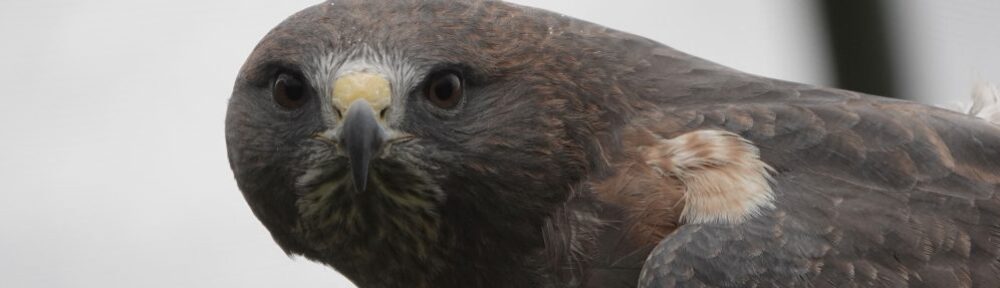
Red-tailed Hawk 26-007 was found near La Grande, OR unable to fly. The hawk was emaciated, it’s left foot was clenched, there was a minor abrasion on the left hock and a noticeable clicking sound in the left shoulder. An x-ray showed increased density in the left hip, but no fractures.
The most likely causes for the bird’s condition were electrocution, collision with a vehicle and/or HPAI. We ruled out electrocution during the exam. The prognosis for recovery was poor and the hawk was euthanized. The results of an HPAI test will be available later in the week. The x-ray below shows very little muscle, typical of an emaciated bird.
Great Horned Owl 26-008 was found near the USDA agricultural Research Station. It had a wound on the right elbow and punctures on the right foot indicating it might have been electrocuted. X-rays showed fractures in the right scapula, right elbow and left tarsometatarsus, a dislocated right shoulder and hip, and emaciation. A collision with a vehicle seemed the most likely explanation for the injuries. Results of an HPAI test will tell us if the owl was also suffering from the virus.
Thank you to all who attended BMW’s Membership meeting on Saturday. Your input and involvement as we prepare for a new clinic and the challenges of 2026 are invaluable. Below is a graphic that Winnie created to summarize 2025 accomplishments.
After our meeting we welcomed the 4-H Clover Buds. They learned about BMW’s Education Birds and then dissected owl pellets. Many took home their collection of rodent bones they found in the pellets.
I feel only a twinge of guilt about commenting on our frigid temperatures when many parts of the country are significantly colder, but it is cold! The low last night was 16 degrees. The predicted high today, Sunday, is 32 degrees. The sun is shining though, so it is a beautiful day!
There was just one admission this past week, American Goldfinch 26-005. The tiny songbird hit a window. The most significant injury appears to be a headache. The little guy was pretty feisty this morning so hopefully after a few days of cage rest he will be ready to return to his Pendleton yard.
Annual Membership Meeting
I hope you can join us on Zoom for BMW’s Annual Membership Meeting. One of the topics of discussion will be our updated By-Laws. They can be read or downloaded at: https://bluemountainwildlife.org/bmw-bylaws/
The Zoom link will be posted on the website on Friday, January 30, 2026. We look forward to seeing you there!
Tricia and intern Enxin traveled to La Grande and released Northern Pygmy Owl 25-524 this past week. The owl was admitted on 11/21/25 with a dislocated scapula (shoulder blade). Although it removed its wing bandage almost immediately, cage rest did the trick. The owl was banded and released near where it had been found.
USFWS called regarding a golden eagle BMW had rehabilitated after it had been struck by a vehicle in August, 2024. It had been banded and released one month later. The eagle was trapped near Baker City and will be part of a long-term golden eagle study. It was fitted with a transmitter that will allow its movements to be tracked via satellite telemetry. BMW will be updated regarding the eagle’s movements. It is approaching breeding age and may well find a mate this year. Usually when we receive information about a banded bird, the bird has died. It is exciting and rewarding to know an eagle that BMW rehabilitated is thriving 1 1/2 years after release and now will contribute to our knowledge of eagles in the wild.