Sharpies Are Back

Sharp-shined Hawk 25-486 was admitted on Wednesday, a sure indication that fall migration is underway, as we see these small hawks during the spring and fall. They are bird hunters. Instead of catching a bird, the hawk’s feathers were tangled with weed seed, making him unable to fly. Once the seeds were removed his feathers looked a bit frazzled, but after a few days of preening and dining on coturnix quail he was flying well and released. 

Three Great Horned Owls were admitted this past week, all were emaciated. In addition to being extremely thin, owl 25-483 had a fractured left ulna. The prognosis for the bird’s recovery was very poor and it was euthanized.

Hip and spinal injuries seemed to be the cause of emaciation for Great Horned Owl 25-485. The owl’s packed cell volume (the percentage of red blood cells in the blood, PCV) was 38. Its total protein was 1.1. Both of those values were artificially elevated due to the bird’s dehydrated condition. If hydrated,  the owl’s total protein would be less than 1.0. In general, we cannot save a bird whose total protein is less than 2.0. Euthanasia was the most humane option. Below is the radiograph of the owl.

Great Horned Owl 25-487 appeared to have been involved in a collision that fractured several ribs. From the physical exam and blood work, we suspect it had been on the ground starving for more than a week. The PCV was 33, a low value that would probably be below 20 if the bird was hydrated. The total protein was very high at 7.0 and there were cheesy lesions in the bird’s mouth. These are signs of aspergillosis, a fungal infection. The fungus is present in the environment. When birds are stressed they are more susceptible to the fungus. In the bird’s debilitated state, the prognosis for recovery was poor and it was euthanized. 

Below is a photo of intern Rachel examining the owl while it was under anesthesia. Rachel has been part of the BMW team since August 4, assisting on a daily basis wherever needed. We wish her well as she continues her studies at Oregon State University. Thank you Rachel for all your help. 

Rachel and Tricia released a McGillivray’s Warbler at Rice Park…

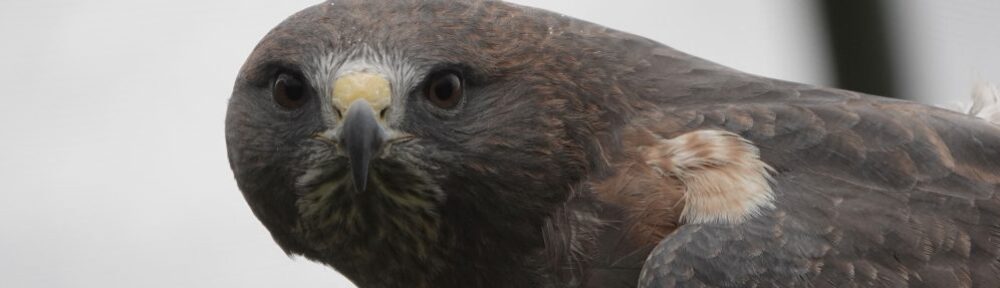
And a young Swainson’s Hawk at BMW…

There are hazards when working at a rehab center, some more serious than others. Swainson’s Hawk Teddy decorated Tricia’s glasses with a mouse tail during an afternoon training session…

New Clinic Coming Soon

Blue Mountain Wildlife’s new clinic is on its way. BMW staff and board members traveled to Pasco this past week to look at a mobil building that will be transformed into a wildlife clinic. Our goal is to have the new clinic operational by the end of the year. There’s a lot of work to do (and opportunities to help). I will keep you posted!

Just three migratory birds were admitted this past week. Black-billed Magpie 25-480 was found on the ground, unable to walk or fly. X-rays showed the bird had several damaged cervical vertebra – his neck was broken. The damage was too extensive to repair and the bird was euthanized. Magpies are a high risk species for Highly Pathogenic Avian Influenza. In order to better understand the bird’s condition, it will be tested for avian influenza.

Western Screech Owl 25-481 was likely struck by a vehicle. An exam and x-rays found fractures in the right shoulder and a dislocated right hip. Again the damage was too extensive to repair and the bird was euthanized.

If you read the journal, you know we x-ray almost all wildlife admitted to BMW. A whole-body radiograph is very helpful in identifying injuries, especially in smaller birds that can be challenging to palpate. The two views we most often take are a ventral-dorsal or VD, with the bird on its back and a lateral, LAT, with the bird lying on its side. The birds are anesthetized to minimize the stress of an exam. Then they are taped to the x-ray table with masking tape so we can step out of the room and take x-rays without exposing staff to radiation. In addition to injuries, you can see the shafts of growing feathers on the radiograph.

Sunset at BMW…

Fall Weather Has Arrived

The 2025 Pendleton Round-Up is over which means planning has begun for the 2026 Round-Up. Blue Mountain Wildlife had a relatively slow week, admitting five migratory birds. 

Barn Owl 25-471 had fractures of the tibia and tibiotarsus in both legs. Euthanasia was the only humane option. 

Western Screech Owl 25-472 died during transportation to Pendleton from La Grande on the tribal bus. The small owl appeared to have had a head injury.

Adult Bald Eagle 25-473 was found near Richland, OR, a very small town 137 miles southeast of Pendleton. It is truly out in the middle of no where! The finders were unable to catch the eagle, but assured us it could not fly. Tricia drove us to the eagle’s location. We were not able to catch the eagle, but we did watch it fly across a field and land 10 feet up in a tree. Chasing him further seemed pointless so we returned to Pendleton.

The next day an Oregon State Patrol trooper was able to catch the eagle. He drove it to La Grande and put it on the tribal bus to Pendleton. Our exam found no fractures, but there are abnormalities in the lungs. The eagle tested negative for avian influenza. Aspergillosis, a fungal infection, is another possibility. He is responding well to supportive care which includes fluids, antibiotics and anti-fungal medications.

Mourning Dove 25-474 may be the last youngster of the season. It was not able to be returned to its parents. Intern Rachel is feeding it formula and seed three times a day. Columbids, doves and pigeons, aren’t fed in the same manner as songbirds. They reach into their mother’s mouth and eat the “crop milk,” the contents of her crop. Initially it is the sloughed lining of her crop. As the babies grow, it also eats seed that she has eaten. The photos show Rachel tubing the young dove formula and offering a seed cup.

Great Horned Owl 25-476 was found in a chicken coop, having just killed a turkey! Fortunately the owners of the turkey were very understanding and brought the starving owl to the wildlife clinic. We are not sure what happened to the owl that made it unable to catch its food, but an x-ray showed subtle differences between the shoulders. Perhaps there was a collision with something. The owl seems to be responding to treatment.

There has been a gentle rain much of the day as I compose this newsletter, as if to close the chapter on summer and welcome fall. 

Cooler Temperatures Have Arrived

Pendleton is bustling with activity as Round-Up Week approaches. We were fortunate to have a quiet week at BMW, admitting just two migratory birds. 

MacGillivray’s Warbler 25-467 is missing many wing and tail feathers after being brought into a house by a cat. We suspect it first hit a window. No fractures were apparent on an x-ray. We are hopeful it can quickly regrow the feathers in time for fall migration.

American Crow 25-468 was found in La Grande. An x-ray showed significant damage in its left shoulder, including a coracoid fracture, as well as damage to the pelvis. It was likely struck by a vehicle. The injuries were too extensive repair and the crow was euthanized.

Fire danger is still high throughout the west. So far, none of the fires have been close, but the smoky air results in beautiful sunrises. Tricia captured the photo below…

Thank you to all who have donated artificial Christmas trees. Barn Owl Helen really likes hers!